
Mariana Romero Roy
Although the Latin American region has made significant progress in recent decades in terms of healthcare quality and disease prevention, it remains at a greater risk for certain communicable diseases than more northern regions. These include mosquito-borne illnesses like dengue, Zika, chikungunya and more. At the same time, emerging disease trends that affect all regions of the globe, such as antibiotic-resistant bacterial strains, are also a growing problem in the Latin American region.
Exploring Causes & Solutions
Some of the factors that lead to the prevalence of these diseases in Latin America, such as the climate and associated organisms that persist as a result, are challenging to control. Despite these obstacles, local healthcare agencies and authorities are still taking steps to mitigate the spread of these diseases.
Let’s take a closer look at how the spread of these diseases and the effort to stop them is impacting the overall healthcare strategy across Latin America, and how your company’s goods and services can be a part of these healthcare initiatives.
A Closer Look at the Disease Data
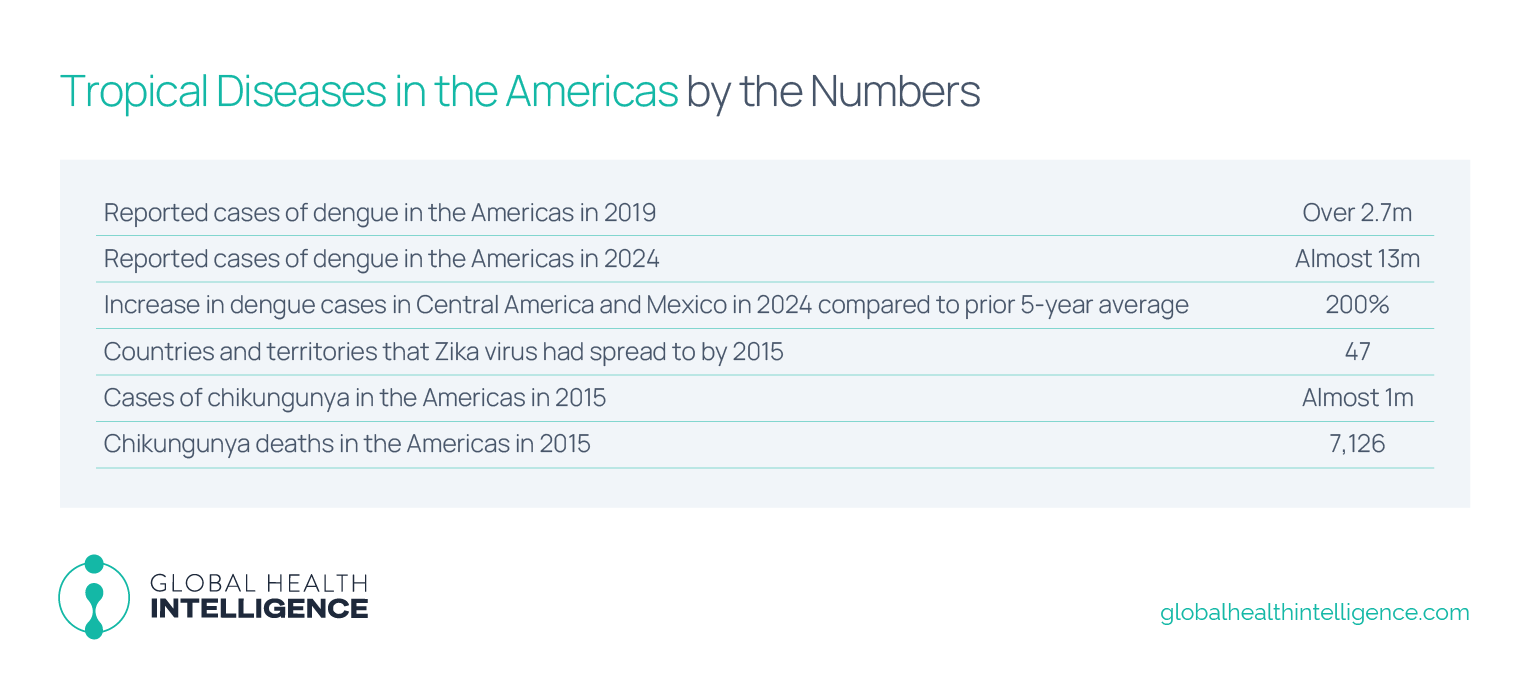
In 2023, researchers for the Pan American Journal of Public Health conducted a systematic review of 95 studies of dengue, chikungunya and Zika virus in Latin America and the Caribbean. While dengue has been common in tropical and subtropical regions for decades, researchers found that its prevalence spiked over the last 10 years.
Zika and chikungunya are newer diseases to Latin America and have followed similar patterns to one another. The first reports of infections for each disease in the region date back to 2013. Similarly, both diseases spiked in prevalence around 2015 and have been decreasing in recent years.
Overall, Brazil and the southern cone region of South America, which includes Argentina, Chile, Uruguay and Paraguay, were historically associated with the highest number of infections. In recent years, however, dengue has been surging most rapidly in Central America and Mexico. Researchers suspect that heatwaves, tropical storms and other severe climate events may be fueling this surge. In fact, these factors have health experts concerned that dengue, chikungunya and Zika virus all may increase in the years ahead.
Factors at Play
As expected, both environmental and socioeconomic factors appear to play a role in the prevalence and spread of these diseases in Latin America. For example, tropical and subtropical climates were strongly linked to the spread of both Zika and chikungunya, while a semi-arid climate is where the spread of dengue was more likely to occur. Interestingly, high temperature, dry weather and increased rainfall were all associated with the spread of the three diseases.
Economic factors also played a role. For example, people with a lower socioeconomic status who lived in densely populated regions were most likely to get and spread the diseases.
Antibiotic-Resistant Bacteria
Another emerging disease trend in Latin America that’s worth keeping an eye on is the rise in antibiotic-resistant strains of bacteria. This trend, of course, is not unique to Latin America, but its prevalence is growing here just as in other regions of the globe. According to a June 2025 article in The American Journal of Medicine, approximately 5 million deaths in 2019 were associated with antibiotic-resistant bacteria, and 11.5% of those deaths occurred in the Americas.
Latin America in particular might be vulnerable to a spike in antibiotic-resistant bacteria in the coming years. Research indicates that the region uses excessive amounts of antibiotics for medical, veterinary and increased production purposes, which could result in a perfect storm of antibiotic-resistant strains of bacteria. Research in the Lancet shows that 322,000 people died due to antibiotic resistance in Latin America and the Caribbean in 2021, and that number is expected to reach 650,000 by 2050, which would give it one of the highest regional rates in the world.
Regional Efforts to Stop the Spread
Despite the challenges, global and local health organizations are working together to try to stop the spread of dengue, chikungunya and Zika virus, as well as antibiotic-resistant bacteria, in Latin America. The World Health Organization, for example, launcher a global strategic plan to fight dengue and other diseases like chikungunya and Zika virus in October 2024. The plan outlines strategies for monitoring, managing, controlling and reducing the transmission of the diseases.
Another interesting initiative from the World Mosquito Program is the breeding and strategic release of Wolbachia mosquitoes. Wolbachia is a safe and natural bacteria that prevents mosquitoes from spreading diseases like dengue, chikungunya and Zika virus. Once these mosquitoes are introduced to an area, they begin breeding with other mosquitoes and pass along the Wolbachia, preventing mosquitoes from spreading the diseases. Initiatives are already underway in Brazil, Mexico, Colombia and El Salvador, as well as other countries around the world.
In regard to antibiotic-resistant bacteria, the Pan American Health Organization (PAHO) and Global Antibiotic Research & Development Partnership (GARDP) are focused on improving access to innovative antibiotics and other medications in the region to stem the tide of projected deaths in 2050. By improving regional access to cutting-edge medications, Latin America can gain the resources it needs to fight the rise in antibiotic-resistant bacteria and their deadly impact.
Key Takeaways for Health Care Companies
As global, regional and local healthcare organizations take on the growing threats of these emerging diseases, medical supplies, drugs and equipment needed to accurately and successfully diagnose, treat and cure people with these diseases are a critical part of the equation to reduce mortality and improve the overall outlook for the region.
The stark reality is that the need for medical supplies related to the treatment of dengue, chikungunya, Zika and antibiotic-resistant bacterial infections is likely to grow throughout the region in the coming years. Companies that are well-positioned to provide these medications and devices can be a key part of the solution when it comes to reducing the overall impact of the deadly diseases on the region.
Next Steps
Contact GHI to learn more about emerging disease trends and their potential impact on the pharmaceutical or medical device and equipment markets in Latin America. Our team of researchers can provide the analysis you need to gain valuable insights to support strategic decision-making in your industry.
************
Sources:
- https://pmc.ncbi.nlm.nih.gov/articles/PMC9910557/
- https://www.nature.com/articles/s41467-024-44799-x
- https://www.mdpi.com/1999-4915/17/1/57
- https://www.paho.org/en/news/8-8-2024-paho-intensifies-support-central-america-control-dengue
- https://www.cdc.gov/dengue/areas-with-risk/index.html
- https://www.climatecentre.org/14980/in-the-americas-surging-dengue-fever-linked-to-climate-change/
- https://www.amjmed.com/article/S0002-9343(25)00058-0/fulltext
- https://www.paho.org/en/news/26-9-2024-paho-and-gardp-will-collaborate-tackle-antibiotic-resistance-latin-america-and
- https://www.thelancet.com/journals/lancet/article/PIIS0140-6736(24)01867-1/fulltext
- https://www.thelancet.com/journals/lanam/article/PIIS2667193X23001357/fulltext
- https://www.who.int/news/item/03-10-2024-who-launches-global-strategic-plan-to-fight-rising-dengue-and-other-aedes-borne-arboviral-diseases
- https://www.paho.org/en/news/10-5-2024-caribbean-mosquito-awareness-week-2024-paho-calls-unite-against-dengue
- https://www.worldmosquitoprogram.org/en/learn/faqs
- https://www.worldmosquitoprogram.org/en/news-stories/media-releases/brazil-fiocruz-and-world-mosquito-program-launch-new-partnership
- https://www.publichealth.med.miami.edu/news/news-releases/2024/experts-address-the-dengue-crisis-in-latin-america-and-the-caribbean/index.html